NSA: Please Turn off the Lights When You Leave. Nothing to See Here.

Linux Advocate Dietrich Schmitz shows how the general public can take action to truly protect their privacy using GnuPG with Evolution email. Read the details.

Mailvelope for Chrome: PGP Encrypted Email Made Easy

Linux Advocate Dietrich Schmitz officially endorses what he deems is a truly secure, easy to use PGP email encryption program. Read the details.

Step off Microsoft's License Treadmill to FOSS Linux

Linux Advocate Dietrich Schmitz reminds CIOs that XP Desktops destined for MS end of life support can be reprovisioned with FOSS Linux to run like brand new. Read how.

Bitcoin is NOT Money -- it's a Commodity

Linux Advocate shares news that the U.S. Treasury will treat Bitcoin as a Commodity 'Investment'. Read the details.

Google Drive Gets a Failing Grade on Privacy Protection

Linux Advocate Dietrich Schmitz puts out a public service privacy warning. Google Drive gets a failing grade on protecting your privacy.

Email: A Fundamentally Broken System

Email needs an overhaul. Privacy must be integrated.

Opinion

Cookie Cutter Distros Don't Cut It

Opinion

The 'Linux Inside' Stigma - It's real and it's a problem.

U.S. Patent and Trademark Office Turn a Deaf Ear

Linux Advocate Dietrich Schmitz reminds readers of a long ago failed petition by Mathematician Prof. Donald Knuth for stopping issuance of Software Patents.

Showing posts with label Free. Show all posts

Saturday, April 6, 2013

Linux Advocates and Freedom Advocates

by Dr. Roy Schestowitz


Some Linux advocates have had the bitter experience of being labelled "faux" advocates and dismissed as being invalid advocates who must be ostracised. People who are Linux advocates arrive from a wide spectrum of backgrounds, either political, philosophical, or whatever. Some Linux advocates engage in parallel activism in the areas of feminism, government transparency, censorship/free speech, and science, to name just a few. Those do not interfere with the goal of advancing Linux, or GNU/Linux.

It is disheartening to see and I regret to say that some Linux advocates get muzzled because to them, GNU/Linux advocacy needs to accompany a broader agenda, which may or may not convey some of the same principles adhered to by GNU/Linux luminaries.

It is fair to say that Linux is apolitical because the project's founder rarely mixes his technical work with political burden. But if by "Linux" one refers to a broader system, for instance GNU/Linux with some vast desktop environment like KDE, then it is fair to say that freedom advocacy deserves plenty of room. KDE and GNU both market themselves as being pro-freedom, more so than Linux.

When Linux advocates argue that freedom takes precedence over power (as in the power of a program), they should not be dismissed as "radical", "extremist", etc. It is most likely that these people actually represent the views of many Linux developers, where by "Linux" they refer to a system far bigger than a kernel. Whether immersion of politics in software contributes to infighting, division and alienation of corporate participation is a subject which merits debate. But open discussion is definitely compatible with the underlying strengths of Free and Open Source software.

-- Dr. Roy Schestowitz


Enhanced by Zemanta

Thursday, April 4, 2013

GNU and Linux: It's Not Just About Attribution But Also Philosophy

by Dr. Roy Schestowitz

Branding is the key


An increasingly-tiring debate over the naming of the (GNU/)Linux operating system was recently rekindled. It occurred rather virally after several Web sites and longtime authors who habitually cover the subject of (GNU/)Linux had weighed in again, opening an ageing jar of worms.

Like many flamewars in the GNU and Linux world, we should accommodate these, not suppress them. With suppression -- after all -- moral advantages are lost. It is widely understood that no corporation wants to project infighting, but in the Free software world corporations are not central. Likewise, branding is not the top priority.

What the argument over the names often boils down to is philosophy, not just attribution or credit. GNU was created with software freedom in mind. Linux, in its genesis, was proprietary until it adopted the GNU GPL licence and then became mainstream. A former colleague of mine was the first to distribute GNU and Linux -- a practice which over time saw the system's name abbreviated to "Linux". The motive for this abbreviation is an interesting subject which merits its own in-depth research.

Rather than argue about what the system should be called we should pay attention to Katherine's post  and ask ourselves, what is it that should be prioritised? Freedom or popularity? These are not mutually-exclusive and describing the problem as such would be a false dichotomy. But practice suggests that those who insist on calling the system just "Linux" are happy to de-emphasise the values originally incorporated into GNU in 1983.

Richard Stallman famously said, "Freedom is having control of your own life. Power is having control over someone else's life." To a lot of people -- yours truly included -- freedom and justice are the goal, software is part of the means. For those to whom branding wars are of greater interest, the "Mac versus PC" (or Apple-branded PC versus Windows-saddled PC) is right around the corner. Or as I often put it, those who do not like Microsoft go to Apple, whereas those who do not like proprietary software turn to GNU/Linux or BSD.

Distributions of GNU/Linux bring yet more brands into the debate, not to mention all the pertinent components that belong neither to GNU nor Linux. Distributions adopt different philosophies which often reflect the views on their founder, e.g. Mark Shuttleworth in the case of Ubuntu and Patrick Volkerding in the case of Slackware Linux, Inc. The brands we use to refer to software often reveals something about our preferences, philosophy, likings and convictions.

Rather than fight over naming of systems let us reason about the innate values each of these brings. Brands are instruments of association, reputation, kinship, and/or status. We need to go deeper and explore what actual substance each of these has got. And we can choose the brands which suit us best.

- Dr. Roy Schestowitz
Enhanced by Zemanta

Thursday, March 28, 2013

Why Advocacy of Linux Must Not Tolerate Censorship

by Dr. Roy Schestowitz

When  the GNU/Linux system was created 30 years ago it was motivated by the belief that -- as much as we may wish to control others -- in order to guarantee everyone's individual freedom we must decentralise and mitigate/neutralise remote control. Isolation between users and developers was annulled. Every user was capable of doing what a developer could. This clever 'hacking' of unwanted relationships between users and developers, such as the exclusivity in access to code, was removed in the licence sense.

Linux thrived owing to the adoption of licensing requirements that assure each and every contributor will retain full control over the entire system, dependants included. It sure is a motivator for many who work for FOSS-centric companies. It's a recruitment tool, too.

If code is law, as Professor Lessig put it, then using code we can control behaviour too. If we are to honour the same principles that motivated the GNU/Linux system, then we must reject the notion of censorship, no matter the platform. Not every commit -- so to speak -- needs to be accepted upstream, but its existence should be allowed and its integrity honoured. Free software is about a diversity of practices, not about imposition from above or the direct and at times explicit coercion of one over another.


Over the years I have come across thin-skinned people that excuse their practice of censorship by calling those whose opinions they do not agree with "trolls", or some of those equally insulting terms like "shills". This labelling is being used suppress comments or writers -- an issue I am familiar with as a former writer for some online news sites. My experience there taught me the role played by editors to whom controversial but otherwise truthful statement are too 'hot' to publish. This is how ideas get silently killed, or spiked. It manufactures the habit of self censorship -- an unnecessary restraint which limits one's scope of thinking.

Speaking for myself, I never deleted comments or suppressed replies, even though many of them (thousands among tens of thousands) included insults and sometimes libel. We must learn to tolerate opposing views and even disruption. That is what freedom is about.

In order to stay true to the standards of Linux and GNU as successful, leading projects that respect and harbour all voices we must stay true to the same principles that made Free software thrive. Failing to do so would lead us down the path of many failed projects which -- unlike Linux -- no longer attract volunteer contributors (who at times, in due course, found way to get paid for it as well).

Advocacy which is hinged on amplifying oneself while silencing the rest is not advocacy, it is marketing. And marketing is almost antithetical to what science-driven programming strives to achieve. In science, bad ideas die based on their merit, or lack thereof. The messengers earn or lose credibility based on their words. Let bad commentary die based on readers' assessments. Don't suppress it at an editorial level as that would project weakness, not strength.


- Dr. Roy Schestowitz
Enhanced by Zemanta

Wednesday, February 20, 2013

A Vision of the Future of FOSS Collaboration

By Guest Writer +Aaron Seigo 

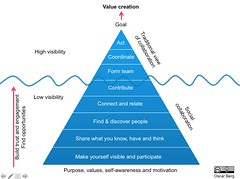
The Collaboration Pyramid
(Photo credit: oscarberg)
Participation and open access are key themes in Free software. It encourages dynamic community structures that blur the line between technology consumer and creator. This has been so successful that echoes of it can be found throughout the technology world from mobile app user engagement to game community content creation. Bringing such interaction patterns into the mainstream is perhaps one of Free software's great social accomplishments. That is not to say that all is well: the topic of user empowerment and participation in Free software is often a contentious one. Depending on the day of the week and whom you ask, you may hear that Free software is an empowering agent for users with low barriers and high levels of interaction with developers .. or that there is a growing disconnect between users and the technology projects. Reality lies somewhere between those two poles, but few doubt that improvements could be made. How to do that is a question that floats in the air without many compelling answers. It turns out that there is another challenge facing Free software which could become a terrific opportunity for improving and even redefining user-developer interaction.