NSA: Please Turn off the Lights When You Leave. Nothing to See Here.

Linux Advocate Dietrich Schmitz shows how the general public can take action to truly protect their privacy using GnuPG with Evolution email. Read the details.

Mailvelope for Chrome: PGP Encrypted Email Made Easy

Linux Advocate Dietrich Schmitz officially endorses what he deems is a truly secure, easy to use PGP email encryption program. Read the details.

Step off Microsoft's License Treadmill to FOSS Linux

Linux Advocate Dietrich Schmitz reminds CIOs that XP Desktops destined for MS end of life support can be reprovisioned with FOSS Linux to run like brand new. Read how.

Bitcoin is NOT Money -- it's a Commodity

Linux Advocate shares news that the U.S. Treasury will treat Bitcoin as a Commodity 'Investment'. Read the details.

Google Drive Gets a Failing Grade on Privacy Protection

Linux Advocate Dietrich Schmitz puts out a public service privacy warning. Google Drive gets a failing grade on protecting your privacy.

Email: A Fundamentally Broken System

Email needs an overhaul. Privacy must be integrated.

Opinion

Cookie Cutter Distros Don't Cut It

Opinion

The 'Linux Inside' Stigma - It's real and it's a problem.

U.S. Patent and Trademark Office Turn a Deaf Ear

Linux Advocate Dietrich Schmitz reminds readers of a long ago failed petition by Mathematician Prof. Donald Knuth for stopping issuance of Software Patents.

Showing posts with label Aaron Seigo. Show all posts

Monday, December 9, 2013

G+ Conversations on Fedora 20, KDE User Perceptions

By Dietrich Schmitz

We had a lively exchange over at Google Plus on Fedora 20, due out tomorrow, 12/10/2013.  (Image credit: www.infusivefive.com)

+Tycho Softworks, a regular participant, initiated the post and shared his thoughts on Fedora 20 and the 'free association' thread of comments took off leading to KDE Plasma Desktop and some of the issues users are confronted with, legitimate or otherwise.

Per usual, perception is reality and I solicited +Aaron Seigo for his view on all things KDE.  He is as always the 'Thinking Man' and has no shortage of interesting things to say.

Here is the Google Plus Post in its entirety (you will need to click through the G+ post's "time" to see the full thread of comments):


Enhanced by Zemanta

Wednesday, November 6, 2013

Bodega - The Missing Piece

by Daniel Sandman

Some might not have heard of it but Bodega, a missing piece in the Linux ecosystem, was released not long ago. Many might not have put much thought about how important this little piece of software really is. As I talked about in my previous article the usual approach commercialized Linux take is to have their ecosystem closed. This can be a danger for open source and do limit the participation of others. In a way it takes the benefit and intent away from what open source really is and should be about. What the infamous +Aaron Seigo (shown right) did was to take the complete opposite approach and made his open. An infrastructure the open source world else would have lacked. This is not a small feat and a crucial part of the open source ecosystem have been filled. (Image credit: Wikipedia.org)

It's not just a content redistribution manager either. It is a more complete solution and on top of that almost completely decentralized. It does not just contain a singular entity where a central power enact it's control. It is built as if he took a blueprint of the real world with individual stores and warehouses and applied it to Bodega. People can join up and create their own business so to speak by partnering up. Which is really exactly how it should be done. I think the future will hold many specialized solutions and just as in the real world competition will be at it's core driving it forward. Anyone who have read his blog posts about the subject can see that he has put a lot of thought into this. He must have understood it's potential very early on and made sure to incorporate as much of it he could in Bodega.


Bodega - An open market for digital content


This means the reach for a content provider could be direct and limitless. It could even create jobs and lower the barrier for people who want to start a business. It is truly a vital piece filled that have been missing. At this point it might only be dream to be able to generate enough revenue to pay a rent but who knows about the future. Someone very service minded and driven could make something really good from it. The potential is really there and as it has just been release a true potential for anyone interested.

As it is still early days it do lack some parts I want to see. The only client I've seen so far is the one for Plasma Active. That is nice but I am missing a GTK one so if someone is up to it, give me a ping. I would love to test it. I know Aaron would love to see one too. He wrote about it on gnome-look.org.
Enhanced by Zemanta

Monday, October 21, 2013

Elitist Mark Shuttleworth Exhibits Temper Tantrum

by Dietrich Schmitz


So, this past Thursday, October 17, 2013, Canonical Ltd. released Ubuntu 13.10 Saucy Salamander.

A post from Canonical's "Self-Appointed Benevolent Dictator for Life", Mark Shuttleworth, appeared the next day.

Honestly, I think what Canonical Ltd. have done insofar as supporting Wayland from its inception up to the point of general release, only to then spring an announcement for Mir, was blatantly transparent and a power grab to seize strategic control of ongoing Display technology driver development. (Image credit: http://oralhealthmatters.blogspot.com)

The end result is that this decision has substantially left Unity on its own island with a 'one of a kind' display driver technology which, as it turns out, nobody is interested in adopting.  The crowd of Distros are all making plans to eventually move to Wayland, at the right time of course, but staying with tried and true X.org for the time being.

Good Decisions, Bad Decisions


So, how exactly does a company make decisions of this kind?  At the very least, one wonders to what extent this is a company driven by any kind of Democratic consensus building.  It would seem, whilst Canonical Ltd. fill the heads of their Developers with the notion that they are 'community' and that their opinions matter,  actions speak louder than words, showing what has been largely regarded as questionable decision making and most likely coming directly from the top.

Smart Scopes, Not so Smart


Take Smart Scopes, for example.  Why would anyone want to forego using an Internet browser to do their web-centric tasks, instead, on the Desktop?  And, why would anyone want to have their privacy details shared with a Canonical Ltd. server to boot?  How does this make sense?  And how is that even the 'smart' thing to do?  Fortunately, Canonical Ltd. saw fit to allow the end user toggle Lens and Smart Scopes features off entirely with a global setting switch.  But this so-called 'feature enhancement' is there now, like it or not.

Arrogance, Elitism, We Know Best


It's one more 'in your face' example of the Canonical Ltd. 'elitist' 'we know what is good for you' mentality which is being fed to the end-user via a 'force feed' funnel method.

Arrogance is such that it can lead those in power to become reckless and lose sight of common sense practical ways of doing things.

It's Our Way or the Highway  


Starting with Unity in Ubuntu 11.04 came the 'parting of the ways' with upstream involvement on shared community decision making (regarding ongoing Gnome development).  Through a series of software revision cycles, Unity evolved further with Canonical taking key pieces of Wayland's infrastructure so as to ensure full control of their own branded Mir Display technology.   At present, Xmir/Mir is only an option with 13.10, but the next version and thereafter will lend full support to Mir display technology and quite possibly no 'fall-back' option for end users.

No, Mr. Shuttleworth is not a happy camper.  It is quite evident in his temper-tantrum post and he goes so far as to label in broad strokes anyone who challenges him as part of the 'Open Source Tea Party'.  Now, in my estimation, that is simply bad form and really underscores his lack of maturity.

No, he's not content to stop there.  He even takes shots at the fine work done by Lennart Poettering and Kay Sievers, on Systemd.

Here's an excerpt of what Mr. Shuttleworth wrote:

"Mir is really important work. When lots of competitors attack a project on purely political grounds, you have to wonder what THEIR agenda is. At least we know now who belongs to the Open Source Tea Party And to put all the hue and cry into context: Mir is relevant for approximately 1% of all developers, just those who think about shell development. Every app developer will consume Mir through their toolkit. By contrast, those same outraged individuals have NIH’d just about every important piece of the stack they can get their hands on… most notably SystemD, which is hugely invasive and hardly justified. What closely to see how competitors to Canonical torture the English language in their efforts to justify how those toolkits should support Windows but not Mir. But we’ll get it done, and it will be amazing."

Unlike Ubuntu, which still employs Upstart, many Distros have already adopted Systemd without hesitation.  There are hold-outs, but the vast majority appear to be in favor of it.

So, why is Mr. Shuttleworth firing volleys across the bows of so many?  It's an interesting question.

Might it be that Mir is encountering difficulties and the continued splintering of derivatives grows as opposition mounts against it use?

On-ramp to Wayland


What Mir has done is essentially drive a wedge into the community and a parting of the ways is occurring as Developers are forced to make a choice as to when to stop supporting X.org and with what technology.  I reached +Aaron Seigo (image right) to have his view on the state of the art in Display Server technology.  Here's what he had to say:

"The KDE community has had a long-term roadmap for Wayland adoption that we've been executing over the last two years. We routinely reexamine such roadmaps to ensure they remain sensible. The broad community and industry support for Wayland, our confidence in the proven team behind it and the high quality releases we've seen thus far have convinced us to stay the course on Wayland. Foundation technologies such as Qt have had high quality Wayland support for several releases and key components for the Plasma Workspace such as the KWin window manager have seen initial work completed. We expect Plasma on Wayland to be ready for production support during the Plasma 2 lifecycle, the next major release which we are currently working on. Having a consistent experience across as much of the technology stack as possible is valuable to our users and partners, and so we are very happy to join the likes of Intel, Red Hat, Jolla, Tizen, GNOME and many others large and small on the road to Wayland."

Conclusions


That's a solid endorsement for Wayland and despite what the future holds for Xmir/Mir, the message is clear: there will be an 'on ramp' for Developers to take in replacement of X.org.

It's not a good sign nor becoming of an Executive Officer to be making such inflammatory statements about those with whom he must cooperate to ensure the success of Linux for many years to come.  Whether or not he intends to 'mend his fence' remains to be seen but it would not only be in his best interests to extend apologies for his inappropriate remarks but also the right thing to do.

-- Dietrich
Enhanced by Zemanta

Tuesday, July 16, 2013

An Unmet Need: Privacy Integration on the PC Desktop

by Dietrich Schmitz

I had a nice chat (Google Plus) today with +Aaron Seigo regarding RetroShare.

He came to the realization as I have that really, thus far, there isn't any form of integrated privacy control built into any computing Desktop system.

Should there be?  We both agreed that the answer is a resounding 'YES'. (Image credit: Wikipedia.org)

It begs the question:

Should privacy software become an integrated feature, much as having a Microsoft Office or LibreOffice?

It also begs the follow-on question:

Is Internet Privacy-mandated software for general utilitarian email, chat, file sharing, voip, needed?

I submit that we are now confronted by the PRISM effect which has revealed that surveillance is ongoing with the assistance of ISPs, software vendors and the like.  Whether the assistance given to the U.S. government is voluntary or involuntary (National Security Letter) is a separate matter.

Has the government run 'rough-shod' over U.S. and foreign Internet users' privacy rights?

That question will be answered eventually and history will show whether privacy truly matters.

But in the meantime, the PRISM story has galvanized public reaction both domestically and internationally and spurred action by national concerns to begin moving their current tenancy on U.S. Cloud ISPs to off-shore safe-haven equivalents.  The general public are left without a solution to the dilemma that presents:

To what extent should I conduct my personal activities on the Internet?

This question will continue to linger and create fear, uncertainty and doubt unless an effort is undertaken to immediately shore up the general perception that Internet privacy is 'non-existent' with exception to a few limited use cases relegated to corporations and technology elite.

At least, with Federally mandated privacy laws in place, e.g., enacting an email encryption standard would have for example manifold benefits.

For one, folding the aged clear text MIME rfc standard into a layer of GPG encryption would ensure email is readable only by its intended recipient(s).  Email encryption is already being used by a small minority of corporations who must secure their correspondences.

But, there is nothing in the way of designing and implementing a 'turn key' drop-dead simple application to which the general public can avail themselves.  To date, the only application on the horizon which approaches the needed degree of usability I have found is RetroShare, and, it has the best opportunity for being further enhanced so as to become more user-friendly and a candidate for Desktop integration, since it is written in trending Qt and is ported to Windows, OSX, Linux and BSD versions.

If such a Federal mandate were legislated, it might also offer financial assistance to developers to defray their cost to create and/or modify software applications so as to become compliant.

Presumably, such a mandate would have to be on a phased schedule to come into full implementation over perhaps one or two years.  And with those dollars such software would be then made available as part of a larger privacy integration package on the Desktop.

The other perhaps as important benefit of such a mandate is that with open standard GPG keys for the sender and recipient, the currently abused/exploited MIME rfc spec sender id field could no longer be 'forged' by spammers.

ISPs could under Federal guidelines for handling email on Mailer daemon transfer agents shunt 'non-compliant' email off-line entirely if the sender's GPG key were not signed by the recipient.  The U.S. postal service could also have their own GPG postal key which by default all users would sign to receive USPS-routed email.  But as with ISPs, the USPS would also not forward email unless the sender's subkey was signed by the recipient.  That would result in a reduction of spam approaching zero and save billions of dollars spent annually on anti-spam software measures and labor expense.

Extending this idea further, having privacy integration in the Desktop ought to include support for other Internet-related activities:  Chat, file sharing, Voice over IP.

So, you begin to see that software such as RetroShare does have a large potential to be adapted for general public use to enforce mandated privacy measures for access to the Internet.

I hope that this post spurs additional feedback and moves the agenda forward for implementing standards of privacy for all who use the Internet.

-- Dietrich
Enhanced by Zemanta

Wednesday, July 3, 2013

The Unwitting Linux Saboteurs

by Dietrich Schmitz

I spend time in my Google Plus private Linux Advocates community sharing ideas and trends with colleagues.

Occasionally, we hit on nuggets of gold and when you least expect it, someone comments and really helps put things into perspective.

Last evening, a dear colleague and friend +Shane Keene was sharing his thoughts about Distro-hopping.  We've jokingly coined the term 'Distroholics' for the uncontrollable tendency to not be satisfied with settling down and using one Distro.

It's easy to understand.  It can turn into a real hobby and is admittedly 'fun' to switch Distros and experiment.  And that's a good thing for those who enjoy doing it.

As for +Shane Keene and myself, and a few others in the LA community, we've reached the point where Distro-hopping has lost its luster.  Shane writes in his post:

"I've long since quit my evil distro hopping ways and settled permanently on Arch as the only one that is exactly what I want it to be, but I have discovered another bad habit of mine: I'm a three-timing, DE/WM slut who is constantly bouncing between Awesome WM, Openbox and KDE. But these days, instead of constantly uninstalling/reinstalling/reconfiguring my environment I just keep all three installed full time and use KDM to manage them."
And, that kicked off a series of comments, which is how we 'chew the fat', so to speak.

But, what I didn't expect was such a insightful exchange from +Aaron Seigo.  Don't misunderstand, Aaron is a regular participant in these exchanges--he's quite 'The Thinker', naturally and we all appreciate when he participates--it's just that I didn't expect his off-topic thought to be relevant, but it actually aligns with a series of posts of mine.  So, really, we are in complete agreement.

It's a good read and here's what he wrote as regards Linux Server and Desktop markets in response to participant +Tim Sparrow's comment - "Maybe if we had only 1 or 2 big names in 2008 around the Vista fiasco time" (emphasis added: mine):

"Looking at the server side, I'm not sure this is true. Despite the wide range of options there, including new comers and deaths in the family, server side Linux took off nicely.
Aside from the demographic differences of the target audiences, there are some striking differences between the two markets: 
* there is a general emphasis on stable transition among server side tools
* there is far less 'fork cause i feel like it' behaviour
* there are far fewer significant differences between using distro X for a web server (e.g.)and distro Y than there is between even the same distros on the desktop
I don't think it is the number of distributions; in theory, more distribution channels should mean more opportunities for marketing and a variety of vertically attuned support offerings. 
I think it comes down to the lack of continuity and an emphasis on infighting rather than gathering market. 
This is a deeply embedded cultural norm in Free software on the desktop. GNOME's early days were soaked in this thinking and it just never really stopped. Now we have a further splintering of the desktops with dangerously little thought to the strategic implications and large %s of the Free software desktop using population putting their support behind things that are new despite having untenable futures and being technically deficient relative to the more mature offerings. 
Desktop Linux's own worst enemy has been the desktop Linux community. 
With one or two environments and a focus on application development (a critical matter) rather than getting all excited about which panel looks better on the left side of the screen (which does not gain more market share, people), even with 10x the number of distributions, we would be much further along. Much further. 
Instead, we engaged in a years long battle of mutual tearing down for no benefit, and it continues today. 
With regret, I consider the various new desktop environments, those who enthusiastically support them and all the distributions and environments drifting towards distro/environment specific applications to be unintentional traitors to the goal of spreading Free software on the desktop. 
Short sighted behaviour is sabotaging things, not the number of distros."

Thank you to all the commentators and especially Aaron.  I hope the readership will reflect long and hard on the above.

-- Dietrich

Enhanced by Zemanta

Monday, April 15, 2013

The Road Not Well Traveled: Two Developers Think Outside the Box

by Dietrich Schmitz

Prevailing wisdom has it that the road well traveled is safest.  That may pertain when traveling cross-country in your car, but, it may not necessarily yield benefits in the computer industry.

You see, we have several forks in the road that are presenting as choices and very quickly developers are want to choose the path well-traveled thinking that such a path will offer the least amount of effort and resistance.  That might make sense initially when short-sighted objectives are being met, as in reduced cost of labor input, but ignoring good design practices by taking shortcuts with direct hard coupling of apis can produce long-term inflexibilities that will make future coding brittle and prone to breakage.  (Image credit: Wikipedia.org)

Adding abstractions for apis is a good way to isolate hard coded system dependencies and using object encapsulation with abstract methods can allow polymorphic behaviors to be applied at a later date and thereby offering extensibility.

The shortest distance between two points is a straight line.  Simply coupling an api (systemd) to a gui (Gnome) is an invitation for future disaster and in-built limitations.  A GUI framework should be loosely coupled to the underlying system and choosing to included hard-coded system dependencies is a recipe for disaster.

But that is the current situation faced by developers who need to make a choice for how to deal with the newest Linux infrastructure changes now being phased in with systemd.

CinnArch is no more as the work necessary to move to systemd was simply prohibitive and an announcement was made to close their doors.

[Edit 4/16/2013 9:00am I stand corrected.  I misunderstood the dynamic with CinnArch and good fellow pointed the error of my ways out here:


Michael Dinon  43 minutes ago
Dietrich what is your source that supports that Cinnarch is no more because of systemd? Cinnarch is no more because of how Cinnamon lags GNOME development. Since Cinnarch was based on Arch and Arch has shipped systemd for sometime I don't think that was the factor.

]


Today, in similar fashion, Fuduntu announced they would also be closing their doors due to their inability to allocate needed resources to address refactoring their code in Gnome 2.34.

Others seeing the writing on the wall include Ikey Doherty, founder of SolusOS, who had his own issues with upstream developers, very recently made the decision to rebase his Distro on a new PiSi package management system in conjunction with a decision to fork Gnome3 to a new GUI called 'Consort'.

Today, +Aaron Seigo  and +Ikey Doherty had a 'public' chat on Google Plus about the latest happenings.  It was in response to +Katherine Noyes  PCWorld story Fuduntu Linux is Closing its Doors.  I have taken to calling Aaron 'The Thinker' lately and I find most of what he says intriguing and quite insightful.  Here's his starting thread in reply to the Noyes story:

The Thinker
A comment +Aaron Seigo wrote on +Dietrich Schmitz's reshare of the original post:
It is interesting that two of the reasons stated were Gtk+ 2 maintenance and systemd dependencies. It demonstrates two things: a) how important it is to pick the horse you bet on carefully (in this case Gtk+ 2) with a good understanding of its future (which mainly lies with the developers who maintain it .. or don't) and b) the impact that Linux middleware churn has on smaller shops.
Personally, I think that if a few of these smaller distributions set aside differences and worked together, they would stand a better chance of creating something with a solid future. Diversity is great, but there's a limit to what the ecosystem can sustain.
The above is the starting comment from Aaron and here is what followed:


Ikey Doherty5:23 PM
+
1
2
1
OK but different projects have different aims. What interest is there in all of these individuals dropping their goals to satisfy a dream that isn't theirs? That's quite a selfish viewpoint, as it takes the joy out of it for the developers

Aaron Seigo5:52 PM
+
1
2
1
+Ikey Doherty In my experience being part of as well as managing projects and teams of wildly, wonderfully independent and brilliant people ... the idea that "we have wildly different goals" is often overstated. Moreover, the idea that "we have different goals, and therefore need to work separately" is often also unfounded.

What I find is that many engineers / software developers struggle to identify issues that don't really matter and spend a lot of time focusing on differences rather than commonalities.

This results in a lot of discussion and division over matters of little consequence and a lot of missed opportunities due to massive duplication of effort and lack of coordination on the common 95% to spare the perceived purity of the 5% in differences.

It's one of the things that drew me to Mer. They understood this pretty deeply, and when we got involved with it we were able to help broaden that mindset even further .. because they were open to it.

Jolla, Nemo and Plasma Active all have unique and divergent goals. We've identified those and marked them out as "not to be tread upon" ground and gotten to work on sharing the remaining 95%. Turns out, we keep finding new opportunities to share now that these doors are open: libhybris, maliit, device adaptations ...

It's one of the things that has drawn me to SDDM. The main developer of SDDM also groks this, and SDDM is now used by a small handful of projects .. with Plasma likely to join when we release Plasma Workspaces 2. This will mean dropping "our own" KDM and even letting go of significant work done with LightDM, but it will ultimately be worth it if it lets us share the 95% that is common so we can all focus on the 5% we care about.

So I'd suggest that the idea that one must either hold onto their dreams and goals or cooperate is a false dichotomy. You can almost always find a group with goals similar enough to your own that you can share the 95% with them. The 5% is yours.
Collapse this comment

Ikey Doherty5:55 PM
+
1
2
1
I don't disagree with people sharing, just when there is room to share something. Sometimes projects differ too much. Take SolusOS 2 for example. Its totally independent and using the PiSi package manager, there's not an awful lot of room for sharing there, and no sense in us joining forces with other projects. However with the Consort Desktop, we intend to bring as many projects together as we can to collaborate, especially in light of the recent dropping of Cinnamon from various projects. It'd be nice for cross-project collaboration on that front.

BTW, SDDM is hot.
Collapse this comment

Aaron Seigo6:26 PM
+Ikey Doherty Ultimately, you're The Source(tm) for where the 95%-5% line is drawn for SolusOS.

I do find it's always good to require a non-self-flattering defense to one's self (or one's team) as to where the value in a project's differences are. As developers, we're often able to sell ourselves on our own ideas very well ... sometimes a little too well ... and are often really bad at playing devil's advocate. Cost/benefit is not always easy to map out, and at times we're not even clear as to which of our plans hold the true value for us. Anyways ...

Bringing people together around Consort Desktop sounds like a very good idea. Desktop environments are a huge amount of work to maintain, and Linux middleware churn does not make that any easier.

To be utterly blunt, I honestly don't think any of the newer desktop env projects have any realistic long term prospects unless they pull together a greater developer audience. Even XFCE is suffering from developer retention right now. Unity has a well-funded and stubborn company backing it which is its possible saving grace. Even if none of them succeed, however, I do expect that at least some of them will push the envelope and in doing so advance the state of the art for Free software desktops.

Compiz is a great example of a star that shone brightly and pushed things forward in important ways even if it eventually has subsided in its importance.

p.s. I don't want to hijack this thread to go off on desktop environment design, but I think there's a strong case to be made for why KDE's Plasma is the best available starting point for a "GNOME 2 like env". If that's at all intriguing to you as a topic of conversation, you know where to find me :)
Collapse this comment

Ikey Doherty6:33 PM
+
1
2
1
Jumping ship to Plasma/Qt + co would cause more problems for me than I'm willing to deal with if I'm perfectly honest. I'll start a PM with you about it if thats ok ?

Aaron Seigo6:38 PM
+
1
2
1
+Ikey Doherty absolutely cool with me; looking forward to the discussion ..

Gonzalo Velasco C.6:48 PM
SystemD I don't know, but from GTK2 to 3 is a smaller change, isn't it? Is it the same to say changing everything related to Gnome 2 for something related to Gnome 3, or is there more?


So, while this road well-traveled may appear to be a good choice beware of major roadwork, detours, and potholes going down that road.  It may be a seemingly good ride right now but alternate routes may be advised. ;)

-- Dietrich


Enhanced by Zemanta

Wednesday, February 20, 2013

A Vision of the Future of FOSS Collaboration

By Guest Writer +Aaron Seigo 

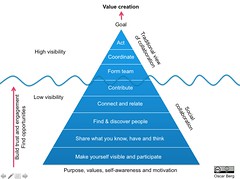
The Collaboration Pyramid
(Photo credit: oscarberg)
Participation and open access are key themes in Free software. It encourages dynamic community structures that blur the line between technology consumer and creator. This has been so successful that echoes of it can be found throughout the technology world from mobile app user engagement to game community content creation. Bringing such interaction patterns into the mainstream is perhaps one of Free software's great social accomplishments. That is not to say that all is well: the topic of user empowerment and participation in Free software is often a contentious one. Depending on the day of the week and whom you ask, you may hear that Free software is an empowering agent for users with low barriers and high levels of interaction with developers .. or that there is a growing disconnect between users and the technology projects. Reality lies somewhere between those two poles, but few doubt that improvements could be made. How to do that is a question that floats in the air without many compelling answers. It turns out that there is another challenge facing Free software which could become a terrific opportunity for improving and even redefining user-developer interaction.

Wednesday, February 6, 2013

Guest Writer Aaron Seigo on Deck


As part of a regular weekly series, Katherine and I will be having Guest Writer appearances on Linux Advocates.


Aaron Seigo, Software Developer
We are pleased to announce that +Aaron Seigo, Software Developer, has kindly and graciously accepted an invitation to write and will be making a 'Guest Writer' appearance this coming week.

From his Wikipedia biography:
Aaron Joseph Seigo (born 1975 in British Columbia, Canada) is a Canadian open source software developer who lives in ZĂĽrich, Switzerland. He has been a KDE contributor since KDE 2 alphas release in 2000.[1] Currently, he works primarily with the Plasma team as project leader and developer, and won Jury's Award of Akademy Awards 2008.[2] He was president of KDE e.V. from July 2007 to July 2009.[3][4]

On behalf of Katherine Noyes, myself, and staff, I would like to extend a special thank you to Aaron for donating his time to Linux Advocates.  --Dietrich


Enhanced by Zemanta